Adv. Sangeeta Desarda: Where Law Meets Social Impact
Adv. Sangeeta Hiralal Desarda didn’t grow up seeing law as a distant institution—something that lived only inside courtrooms and government files. For her, justice was a living value. It existed in conversations at home, in the way education was respected, and in how service to society was treated not as charity, but as responsibility.
From an early age, she noticed what many people only begin to understand much later—that law and governance quietly shape everyday lives, and they shape them unevenly. Women, rural communities, and marginalized groups often experience systems differently. That awareness didn’t make her cynical; it made her purposeful. Somewhere between observing these realities and understanding the weight of constitutional values, a quiet commitment formed: law would not just be her profession—it would be her tool for change.
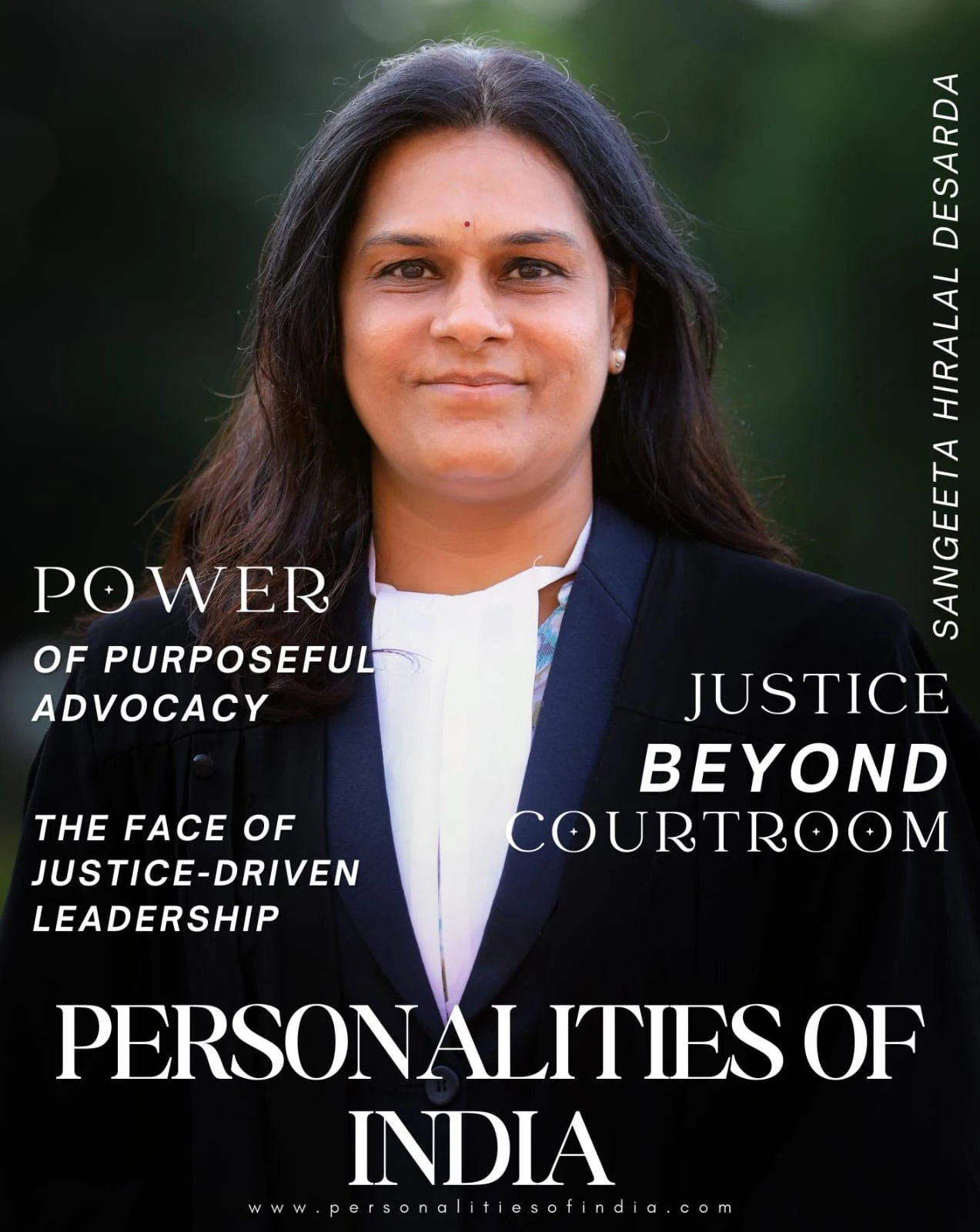
Sangeeta’s interest in public affairs, constitutional principles, and community empowerment was not accidental. Her formative years were filled with a growing consciousness of structural inequities—how power is distributed, how rights are accessed, and how often people suffer not because the law doesn’t exist, but because they don’t know how to reach it.
When she chose law, she didn’t choose it for prestige. She chose it because she believed the legal system—when approached with integrity—can protect dignity, correct injustice, and create accountability.
During her legal education, she found herself drawn deeply to areas that demanded both intellect and empathy. Constitutional law, judicial review, gender justice, environmental protection—these weren’t just subjects to her. They were living frameworks that explained how a democracy functions, and how it can be strengthened.
What made her approach distinct was her refusal to separate theory from reality. While many learn law in textbooks alone, Sangeeta consistently worked to understand how law actually plays out in people’s lives—especially those who stand at the edges of power.
This balance of doctrinal learning and social grounding became central to her professional identity, and remains so even today through her continued engagement with research, policy discourse, and community-based legal work.
In a profession often measured by aggressive wins and loud reputations, Sangeeta’s leadership stands out for something rarer: ethics, clarity, and client-centered advocacy.
As the Co-Founder of Arihant Law, she has worked to build a legal practice anchored in integrity and justice-driven outcomes. Her work spans constitutional matters, civil disputes, socio-legal issues, women’s rights, and cases that require not just legal precision—but human sensitivity.
For her, advocacy is not performance. It is responsibility.
But Sangeeta’s work does not stop where courtrooms end. As the President of the Arihant Foundation, she leads impactful initiatives focused on legal literacy, gender justice, environmental awareness, community empowerment, and youth and adolescent development. Across Maharashtra, the Foundation has supported grassroots outreach, capacity-building programs, and awareness drives that bring legal knowledge and access to justice to the communities that need it most. Because in her world, justice is not only something you argue for—it is something you build, educate, and expand.
Beyond practice and social leadership, Sangeeta’s identity is also deeply academic. Her scholarship explores the very questions that define modern India, including gender equality and women’s rights, climate change law and climate justice, constitutional governance and judicial review, access to justice for rural and vulnerable communities, and social impact legislation and policy reform. She is currently working on projects that examine the historical evolution of gender equality in India, the judiciary’s role in advancing climate justice, and the changing scope of judicial review in contemporary democracies.
Her research is not abstract. It is deeply grounded—built on doctrinal analysis, socio-historical perspectives, and case-based inquiry. The goal is clear: to contribute not just to academic discourse, but to real policy development and meaningful legal reform.
If one theme runs like a pulse through Sangeeta’s journey, it is gender equality. She has actively participated in initiatives addressing gender-based violence, legal awareness for women, and advocacy for equitable workplace and community structures.
Through the Arihant Foundation, she has focused on empowerment through legal knowledge—helping women understand their rights, access justice, and strengthen their long-term social and economic standing. Her academic work mirrors her practice: deep, informed, and shaped by real experience with women navigating systemic challenges.
Sangeeta’s sensitivity toward environmental and sustainability issues is not just professional—it is personal. Influenced by her mother’s work toward sustainable living and organic farming, she grew up with an awareness that the environment is not separate from society—it is the foundation of it.
Her climate justice work explores India’s climate litigation landscape, public interest litigation, and the judiciary’s role in protecting ecological and intergenerational rights.
She focuses particularly on the intersection of climate change, constitutional values, and human dignity—advocating for governance that is responsible, sustainable, and rooted in justice.
Behind her achievements is a story that many women professionals will recognize instantly.
The legal profession is still largely male-dominated, and for Sangeeta, stepping into this space often felt like breaking invisible barriers—again and again. Establishing credibility, asserting her presence, and earning respect required resilience and relentless consistency.
Being a first-generation lawyer added another layer. There was no inherited network, no ready-made legacy, no family pipeline into courtrooms. Everything had to be built from scratch—through discipline, persistence, and self-belief.
In her early days, she faced discouragement that went beyond doubt. People openly told her law was not suitable for women. Some even claimed advocacy was not a “white-collar” profession and suggested lawyers had to compromise on truth and ethics.
Even in court, early mistakes were laughed at instead of guided.
But Sangeeta responded in the only way she believed was worthy—not with arguments, but with excellence.
Hard work. Preparation. Integrity. Ethical practice.
Over time, her conduct became her reputation. The very people who once doubted her began to acknowledge her sincerity, intellectual strength, and professionalism.
Sangeeta’s journey is also a story of support systems done right. She pursued her LLB and LLM after marriage—something that requires not only ambition, but a strong environment. Her parents, in-laws, and especially her husband stood firmly by her, ensuring she never had to choose between responsibilities and aspirations.
Her inspiration is deeply rooted in family. Her father, a respected economist and social worker, instilled in her a strong sense of justice and social responsibility, while her mother, through her work in organic farming and wellness publications, shaped Sangeeta’s sensitivity toward sustainability, health, and a more conscious way of living.
Even her childhood exposure to social movements became foundational. She had opportunities to engage with leaders such as Sunderlal Bahuguna, Medha Patkar, and Vandana Shiva—experiences that grounded her belief that law must protect both society and the environment.
There are many milestones in Sangeeta’s journey, but a few stand out as deeply personal victories. She established herself as a first-generation advocate in a male-dominated profession through ethics, perseverance, and consistent hard work. She went on to co-found Arihant Law, building a practice defined by transparency, clarity, and justice-driven advocacy. As the President of Arihant Foundation, she has created meaningful grassroots impact through legal literacy, empowerment, and environmental awareness initiatives. Her work has also reached global platforms, including her role as a Commitment Maker at the UN-led Generation Equality Forum and her active engagement in COP28 and COP29 discussions. Along the way, she has received national and international recognition, including the 100 Women Icon Award, along with features in Femme Times and leading lifestyle magazines that acknowledge her contributions to law, social justice, and women’s leadership.
For Sangeeta, the future is not about personal expansion alone—it is about deeper impact.
Her vision is rooted in three powerful directions. She aims to work extensively for underserved and marginalized communities, ensuring greater access to justice, education, and dignity. Alongside this, she is deeply committed to climate action and sustainability, contributing through legal advocacy, policy engagement, and community awareness to strengthen environmental protection and responsible governance. She is also particularly focused on adolescent girls and leadership mentorship, supporting skill development, confidence-building, and leadership training so young women grow up believing they belong everywhere power exists. At the heart of it all, women’s empowerment remains central to her purpose—not as a slogan, but as a long-term mission.
Sangeeta Desarda’s journey is not simply about becoming an advocate. It is about becoming a voice that stands where law, research, and social impact meet.
Her guiding belief remains:
“Justice is not merely a profession—it is a promise to society.”
And in every case she takes, every foundation initiative she leads, every research paper she writes, and every girl she mentors—she continues to keep that promise.