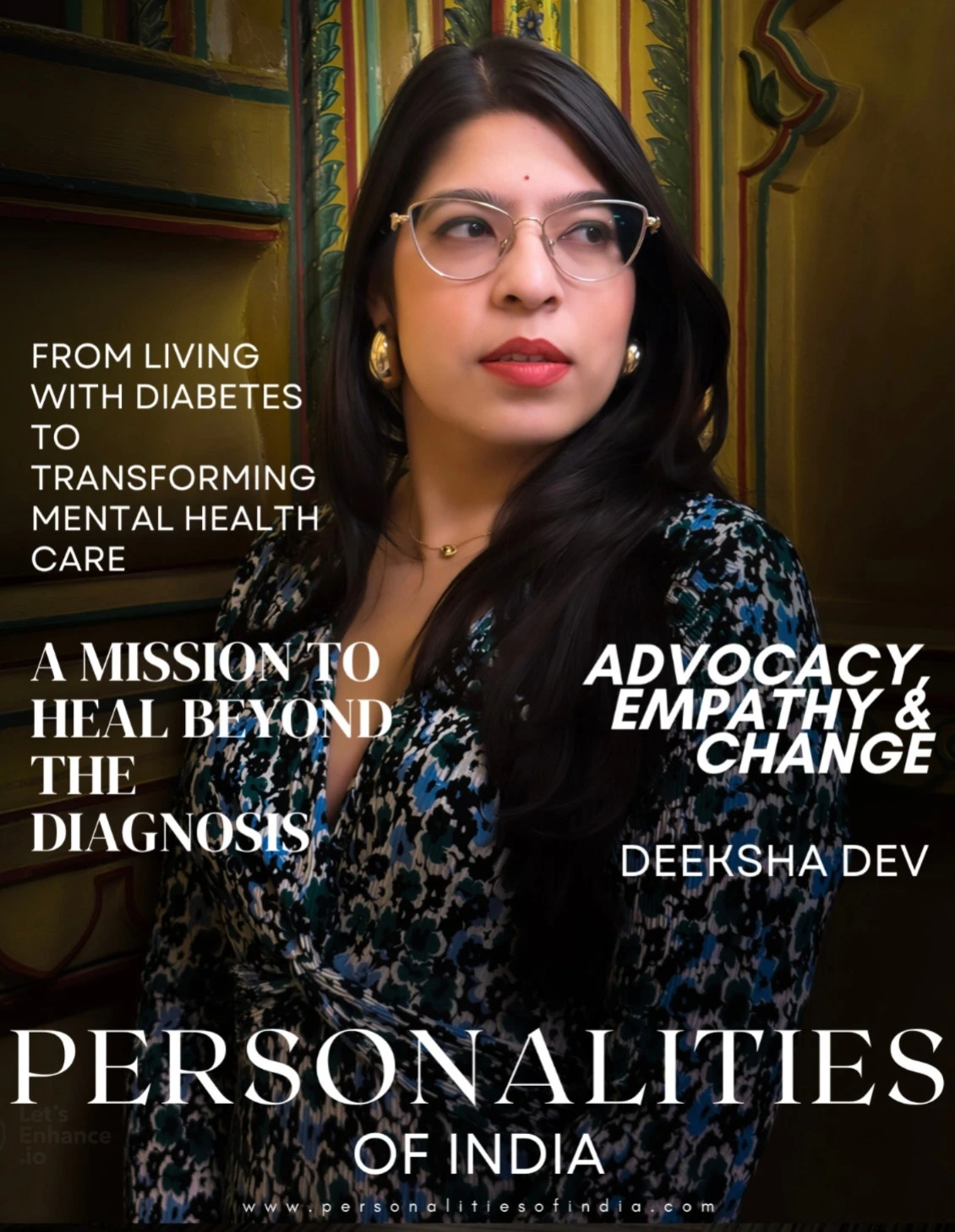
Deeksha Dev: Redefining Healthcare Through Mental Health and Lived Experience
In 2019, Deeksha Dev walked into a hospital room that would change the direction of her life. She was pursuing her Master's in Applied Psychology, specialising in Counselling Psychology, from the Tata Institute of Social Sciences (TISS), Mumbai, and completing her final internship at PGIMER, Chandigarh. During that internship, she was called to the paediatric endocrinology ward, where a newly diagnosed child had been admitted. The child's parents were devastated. They were crying, asking questions and struggling to imagine what life would look like for their family after the diagnosis.
For Deeksha, the moment was deeply personal.
She had been diagnosed with Type 1 diabetes at PGIMER when she was just four years old. Although she had no memory of her diagnosis, standing in the same hospital years later brought an unexpected realisation: she was now witnessing what her own parents might have experienced nearly two decades earlier.
When the child's parents asked whether their child would be okay, Deeksha understood that they needed more than medical explanations. They needed someone who could sit beside them, acknowledge their fear and offer reassurance grounded in lived experience.
She told them that she had been living with Type 1 diabetes for 17 years. Their surprise was immediate. They could hardly believe that someone living with the condition could lead a full life without it being apparent to everyone around her. When they asked whether their child would eventually be able to get married, Deeksha recognised a question she would encounter repeatedly in her work with families affected by Type 1 diabetes.
Could their child live independently? Travel alone? Enjoy their favourite foods? Build relationships? Pursue their ambitions? Have the future they had imagined?
Behind these questions lay a much larger concern: the emotional burden of living with a chronic condition, and the fear that a diagnosis might determine the course of an entire life.
That day, Deeksha began to recognise a gap in healthcare. While doctors were addressing the child's medical needs, the family also needed emotional support. The problem was not a lack of concern among healthcare professionals; it was that an overburdened system often left little time to ask families how they were coping.
As a psychology graduate, she did not yet fully understand the structural challenges behind this gap. She simply knew that something important was missing.
With greater clinical exposure, she began noticing similar patterns across chronic illnesses. She realised that acknowledging the importance of mental health was not enough. People needed access to psychological support at the point when they needed it, integrated into the care they were already receiving.
That understanding would eventually lead her to establish Alignia Wellness Foundation, an organisation focused on making mental health support an accessible and meaningful part of chronic illness care.
Finding Her Place in the World of Mental Health Advocacy
Deeksha's journey towards building an organisation was not a straightforward progression from education to entrepreneurship. It involved difficult professional decisions, uncertainty and a willingness to question whether the work she was doing aligned with the person she wanted to become.
At one point, she was working as a Director of Advocacy and Experience. Despite holding a significant position, she felt increasingly disconnected from the psychology education she had worked so hard to pursue at TISS. Her degree, she felt, was gathering dust while her professional responsibilities took her further away from the work she had originally trained to do.
Leaving was not easy. Workplace power dynamics had begun taking a toll, and stepping away meant accepting the uncertainty of starting again. Eventually, however, she recognised that remaining in a role that no longer felt right carried its own cost.
Her decision reflected a growing clarity about what mattered to her: she wanted to work where psychology, healthcare and people's lived experiences intersected.
Yet identifying the problem was only the beginning. One of her biggest professional challenges was getting people to move beyond conversations about psychosocial care and towards actual implementation.
Mental health support was widely acknowledged as important. Therapy was frequently discussed, and the language of patient-centred care was familiar across professional spaces. But Deeksha wanted to ask a more practical question: what did that support look like in a clinic, and how did a person living with a chronic condition actually receive it?
At a conference, she once raised this question with a clinician. Although she appreciated the work being done, she wanted to understand the strategy for implementing psychosocial care on the ground. The conversation was uncomfortable, and there was no clear answer.
For Deeksha, however, these were precisely the conversations that needed to happen. Good intentions had to translate into systems, services and measurable improvements in people's lives.
She has never been comfortable agreeing with senior professionals simply because of their position or because everyone else in the room agrees with them. If she notices a gap, she is willing to point it out, even when doing so creates discomfort. This approach has sometimes made professional life difficult, but it has also helped her remain honest about the work she wants to pursue.
The Emotional Burden Behind a Chronic Diagnosis
One of the biggest barriers Deeksha has encountered is the stigma surrounding mental health. The belief that seeking psychological support means something is fundamentally wrong with a person remains deeply rooted in society.
When this stigma intersects with a chronic condition, the emotional burden can become even more complicated. A person living with Type 1 diabetes may already be dealing with the demands of daily management, uncertainty and physical health concerns. If they also experience anxiety, distress or emotional exhaustion, they may interpret these feelings as another sign that something is wrong with them.
Many people struggle to find the words to describe what they are experiencing, let alone acknowledge that professional support might help. Changing this perception and making conversations about mental health feel safe and acceptable has therefore become an important part of Deeksha's advocacy.
At the same time, her work has taught her that emotional well-being cannot be separated from the material realities of life.
How can someone be expected to focus on self-awareness or therapy if they do not have reliable access to insulin, adequate food, personal safety or shelter? In such circumstances, distress cannot be understood independently of the conditions producing it.
This perspective has made Deeksha increasingly conscious of health inequities and the structural barriers people face. When she encounters someone dealing with an immediate and pressing problem, she believes the responsible response may be to connect them with organisations or individuals equipped to help, rather than attempting to solve everything herself.
For her, meaningful mental health care begins with understanding the whole person, including the circumstances that shape their everyday life.
Building Alignia: From an Idea to an Organisation
Establishing Alignia Wellness Foundation has introduced Deeksha to a different set of challenges. Clinical understanding and advocacy experience, while essential, do not automatically equip someone to build and sustain an organisation.
She has had to learn about fundraising, grant writing, accounting, financial management, organisational structures, partnerships and the practical demands of developing interventions. Each day brings new questions about whether the organisation's structure is effective, whether its interventions are working, whether funding is ethically sourced and whether the voices of the people it serves are genuinely being heard.
For Deeksha, leadership is not simply about holding a title or directing a team. It requires the willingness to question existing approaches, identify what is not working and rebuild when necessary.
Finding the right people has also been a significant challenge. She wants to work with individuals who are emotionally intelligent, consistent, sincere in their intentions and genuinely committed to the mission. At the same time, she recognises that an organisation cannot depend indefinitely on goodwill and unpaid labour. Meaningful work must also become financially sustainable if it is to continue making an impact.
The journey has often required her to learn things she never expected to encounter when she first studied psychology. It has also pushed her to revisit health psychology from a wider perspective, connecting individual experiences with institutional structures and larger questions of access.
There are days when she questions whether she can do everything the work demands. She does not pretend to have every answer. Instead, she has learned to acknowledge difficult emotions without allowing them to dictate her final decisions.
Living with Type 1 diabetes has shaped this approach. Over the years, she has learned that problems sometimes require a different perspective before a possible solution becomes visible. She applies the same thinking to her professional life: give herself time to feel, reflect on what went wrong and then decide what needs to happen next.
Her parents, brother and friends have been a vital source of support throughout this process. They have helped her through uncertainty and reminded her that failure does not have to be the end of a story.
She has also developed what she jokingly calls the "Council of Deekshas" for moments when several problems demand attention at once. She mentally divides the challenges among different versions of herself and tackles them one at a time. It may sound unconventional, but it helps her find a way forward when everything seems urgent.
From Individual Support to Systemic Change
As Deeksha's work has evolved, so has her understanding of what it takes to create lasting change.
Supporting individuals directly matters. Helping one person access care or enabling a family to understand a diagnosis can make a profound difference. But she recognises that reaching thousands or millions of people requires more than individual effort.
It requires data, systems thinking, research, effective interventions and policy change.
This realisation has influenced the way she approaches Alignia and the wider field of mental health advocacy. Rather than focusing only on providing support in individual cases, she wants to understand which approaches work, why they work and how they can be adapted to reach more people.
Her ambition is to develop and test practical interventions, generate meaningful evidence and take those findings to healthcare systems and policymakers. She wants to retain the ability to listen closely to an individual's experience while also examining the structures that determine whether millions of people receive appropriate care.
For Deeksha, these two approaches are inseparable. Personal stories reveal the human consequences of gaps in healthcare, while research and policy offer opportunities to address those gaps at scale.
Her experience with the International Diabetes Federation helped lay the foundation for this broader vision. Selected as a Young Leader in Diabetes for 2022-2024, she represented India internationally and had the opportunity to work specifically on mental health in diabetes. The project she began during that period eventually developed into Alignia. Today, she also mentors the current Indian representative, an experience she finds deeply fulfilling.
The journey has reinforced her belief that advocacy becomes more effective when it connects lived experience with evidence, collaboration and practical implementation.
Turning Lived Experience into Collective Action
Deeksha's contributions to the Type 1 diabetes community extend beyond her organisational work. Over the years, she has helped build connections among people living with the condition by organising meetups and awareness sessions across cities.
These gatherings created opportunities for people to talk openly, play games, share food and spend time with others who understood their experiences. For Deeksha, the value of these spaces lay not only in spreading awareness but also in creating trust and a sense of belonging.
Even though she is less active in organising these activities than she once was, people continue to reach out to her when they need help or someone who understands their concerns.
One experience remains particularly meaningful to her. A professor who had attended one of her awareness sessions remembered the four Ts used to explain the warning signs of Type 1 diabetes. When the professor later recognised those signs in her own child, she sought medical attention early. According to Deeksha, this helped the child receive a diagnosis before developing diabetic ketoacidosis (DKA) and requiring hospitalisation.
For her, this was a powerful reminder that awareness can have practical consequences. Information shared in one setting can help someone recognise a problem in another, potentially changing the course of what happens next.
Her advocacy has also reached international health policy discussions. Deeksha was one of ten Type 1 diabetes advocates who worked with Médecins Sans Frontières on a petition calling for rapid-acting insulin analogues to be included in the World Health Organization's Essential Medicines List. She helped mobilise signatures within Type 1 diabetes communities and submitted a rebuttal to the WHO, drawing on her experience as both a person living with the condition and an advocate.
The initiative demonstrated the importance of collective action. People directly affected by healthcare decisions bring a perspective that cannot be replaced by discussion alone. When their experiences are organised into a shared effort, they can contribute to conversations about access and treatment at a wider level.
In 2026, Deeksha was also recognised as one of The 100 Most Iconic Women of India for her work in Type 1 diabetes advocacy and mental health. Although she admits that self-doubt sometimes makes it difficult to fully accept recognition, she sees the honour as meaningful because it acknowledges work she has pursued out of genuine concern for the people affected.
For her, the most important achievements are not always individual accolades. They are also the relationships she has built, the people she has mentored and the moments when someone has been able to make a better-informed decision because of something she helped create.
A Future That Connects People, Research and Policy
Deeksha does not have a rigid five- or ten-year plan, and she is comfortable with that uncertainty. What she does know is the kind of work she wants to continue doing and the values she wants her life to reflect.
Professionally, she hopes to remain active at the intersection of mental health, healthcare and lived experience. She wants to continue working as a psychologist, conduct research, engage with communities and understand how healthcare systems operate. Over time, she hopes to influence policy and contribute to conversations that improve how care is delivered.
Through Alignia, she wants to build interventions that work in real-world settings, evaluate their impact and use the resulting evidence to inform larger systems. She also hopes to represent India in global discussions on healthcare and contribute to efforts that make psychological support a more accessible part of chronic illness management.
Yet her vision of the future is not limited to professional accomplishments.
She wants to travel, experience different cultures, discover new food, cook and bake, visit museums, create art, listen to music, scuba dive, dance and attend live concerts by artists she admires. She wants to spend time with friends across different cities, visit family and enjoy the ordinary moments that make life meaningful.
Sometimes, she imagines that her most treasured memories will not be associated with professional milestones at all. They might simply involve sitting between her parents on a bed and watching a ridiculous television show with them because it makes them happy.
These aspirations reveal another important part of her philosophy: a meaningful life should leave room for relationships, curiosity, pleasure and experiences beyond work. She cares deeply about her mission, but she does not want her entire identity to become defined by it.
Ultimately, she hopes that the work she builds will help others living with chronic conditions experience the same freedom. A diagnosis may become part of a person's life, but it should not have to become the entirety of it.
Building a Different Kind of Healthcare Future
For Deeksha Dev, the journey from a hospital corridor in Chandigarh to founding Alignia Wellness Foundation has been shaped by a simple but important realisation: treating an illness is not always the same as caring for the person living with it.
Her personal experience with Type 1 diabetes gave her an understanding of the questions families carry after a diagnosis. Her training in counselling psychology helped her recognise the emotional dimensions of those experiences. Advocacy work and clinical exposure then revealed the wider gap between acknowledging mental health needs and making support available in practice.
Today, she is working to connect these insights through community engagement, research, practical interventions and a broader vision for healthcare.
She remains candid about the difficulties of building an organisation, the uncertainty of professional life and the fact that she has not figured everything out. What has changed is her ability to recognise what needs attention, learn from setbacks and decide what to do next.
Her story is not about having every step planned in advance. It is about allowing lived experience to inform meaningful work, asking difficult questions when existing systems fall short and building solutions that respond to people's actual needs.
And at the heart of that mission is a belief that a chronic diagnosis should never erase a person's ambitions, relationships or right to enjoy life. Through her work, Deeksha hopes to help create a future in which healthcare recognises not only the condition but also the person, the family and the life that exists beyond it.