Dr. Arpit Bansal: From the Operating Room to the Science of Longevity
There is a particular kind of silence that exists beneath the surface of the ocean. For Dr. Arpit Bansal, that silence became more than an escape—it became a lesson.
After sixteen years in surgery, countless operations, advanced laparoscopic procedures, cancer surgeries and a fellowship in the UK, Dr. Bansal had become deeply familiar with the intensity of the operating room. Yet it was through birdwatching, diving and the study of human states that he began asking a different kind of medical question:
What if healing is not only about removing disease, but understanding why it appeared in the first place?
That question would take him from the operating table to the ocean, from conventional surgical practice to longevity science, and from treating illness to exploring the possibility of extending healthy human life.
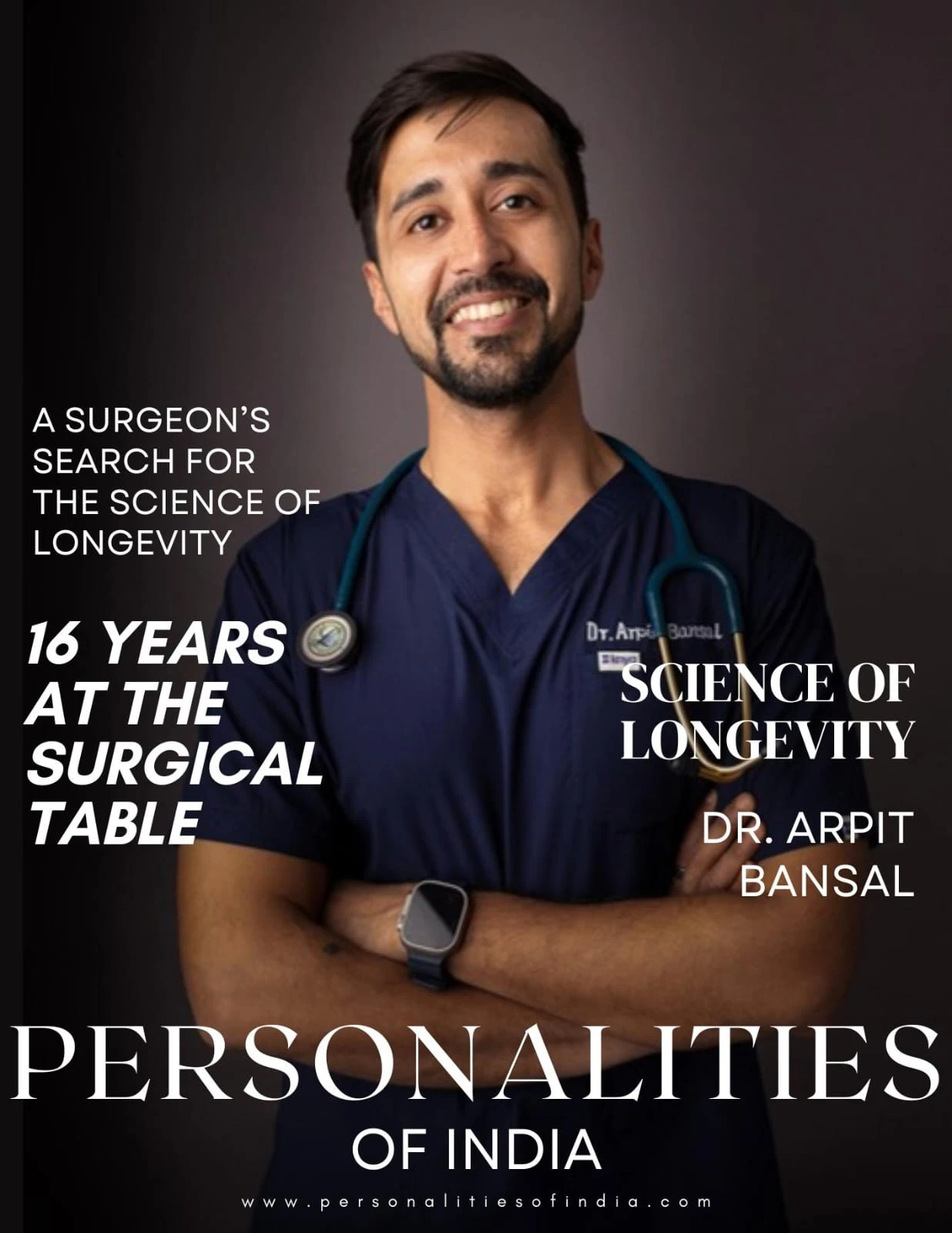
A Childhood Surrounded by Surgery
The story began long before medical school.
Both of Dr. Bansal's parents were surgeons in Allahabad. As a child, he watched his father walk through the city and witnessed something he never forgot.
People would stop him on the street and touch his feet.
It was not because he was famous. It was because of what he had done for their families.
He had helped give people back their fathers, wives, husbands and children.
For young Arpit, that was the meaning of being a doctor.
Years later, when it was time to choose his own profession, surgery felt like a natural continuation of that legacy.
In 2010, he joined MS Surgery.
What followed was sixteen years of continuous training and refinement—advanced laparoscopic surgery, cancer surgery and a fellowship in the UK. Every stage added another layer to his understanding of the profession.
For him, surgery was never a qualification that could simply be completed.
It was a craft.
And a craft, he believes, demands lifelong sharpening.
Choosing the Highest Stakes
Dr. Bansal eventually chose cancer surgery.
It was not the easiest branch to choose. It was the hardest.
Cancer places surgeons in situations where technical precision meets enormous emotional stakes. Every operation carries the weight of a patient's future and a family's hopes.
Dr. Bansal wanted exactly that responsibility.
If he was going to spend his life at an operating table, he wanted to work where the stakes were highest.
But oncology also introduced him to the most difficult part of medicine—the patients who could not be saved.
For years, his response was to keep operating.
More patients. More surgeries. More work.
The volume helped him keep moving.
Until it didn't.
The First Lesson Came from a Bird
Long before the ocean became part of his life, Dr. Bansal had discovered birdwatching.
At first, it may have seemed far removed from surgery.
But birdwatching taught him something that would eventually become central to his thinking.
You cannot rush a bird.
You have to sit. Wait. Observe.
You begin noticing the environment around it—the water, the trees, the insects, the season and the subtle changes in the ecosystem.
The lesson was simple:
You cannot understand the bird without understanding its environment.
Years later, Dr. Bansal began to realise that perhaps medicine had become too focused on the specimen.
The tumour.
The disease.
The symptom.
The diagnosis.
He began wondering whether medicine should also be looking at the ecosystem surrounding the patient.
Then Came the Ocean
Five years ago, Dr. Bansal started diving.
The experience changed something fundamental.
The operating room had trained him to remain constantly alert. The ocean taught him to become still.
Underwater, the urgency softened.
The mind quietened.
The body entered a different state.
He began describing these contrasting states as Red Mind and Blue Mind.
Red Mind represents chronic sympathetic overdrive—the state in which many doctors and patients spend much of their lives.
Blue Mind represents calm, coherence and a deeper sense of physiological balance.
Learning how to move between these states became an important part of Dr. Bansal's own transformation.
And the ocean became more than a passion.
It became a teacher.
When the Surgeon Began Questioning Medicine
The biggest turning point in Dr. Bansal's journey was not a surgical breakthrough.
It was a question.
After years of excellent outcomes, he began confronting a limitation of modern medicine.
Medicine can be extraordinarily effective at removing disease.
But removing disease does not always explain its origin.
A surgeon can remove a tumour with extraordinary precision and still be left asking:
Why did it grow in the first place?
That question shook him intellectually.
The operating room had taught him how to remove disease.
The ocean encouraged him to look beneath the surface.
And birdwatching had already taught him the principle: look at the system, not just the specimen.
Building a Different Kind of Healthcare Vision
While helping lead Jeevan Jyoti, the 200-bed multispecialty hospital his family built in Allahabad, Dr. Bansal faced a choice.
He could remain within the boundaries of conventional surgery.
Or he could explore the questions that had been growing inside him.
He chose to explore.
Sleep.
Sunlight.
Breath.
Cold exposure.
Red light.
Meditation.
Belief.
Coherence.
He did not see these as replacements for modern medicine.
Instead, he began looking at them as components that could exist underneath and alongside modern treatment.
The goal was not to abandon surgery.
It was to understand health more completely.
From Living Longer to Living Better
This philosophy eventually led Dr. Bansal toward longevity science.
For him, longevity is not simply about adding years to life.
It is about adding healthier years.
That is the philosophy behind his work as Scientific Chair of the Longevity Summit India, where he is working to bring global longevity science into the Indian healthcare ecosystem.
His vision is ambitious: take longevity out of exclusive boutique clinics and bring it into Indian hospitals.
Make it accessible.
Make it evidence-led.
Make it affordable.
And most importantly, develop it with Indian data and Indian realities in mind.
He believes that a patient in Allahabad should ultimately have access to the same preventive science as a patient in Zurich.
Writing the Science of Flow
Dr. Bansal's exploration has also moved into the world of books.
Through The Blue Mind and The Purple Mind Code, he explores the neuroscience of flow and attempts to translate complex ideas into language that a non-scientist can understand.
For him, flow is not merely a fashionable concept.
It is a state that can be trained.
And once again, his work reflects the same philosophy that has shaped his medical career—take complicated ideas and make them useful.
The Aquaman Biohacker
His relationship with water eventually gave rise to another identity: the Aquaman Biohacker.
It represents his attempt to bring together traditional wisdom and modern science while exploring the potential influence of water, light, breath and coherence on human wellbeing.
But beneath the intriguing title is a serious scientific curiosity.
Dr. Bansal is interested in what happens when we look at health beyond the hospital bed and operating table.
What happens when environmental factors, behaviour, physiology and mental states become part of the conversation?
What happens when prevention becomes as important as intervention?
Those are the questions driving his next chapter.
A Surgeon With a Bigger Mission
Dr. Arpit Bansal began his journey by watching his parents heal people in Allahabad.
He entered surgical training in 2010 and spent sixteen years sharpening his craft.
He chose cancer surgery because he wanted to take on the highest stakes.
He learned to deal with loss.
Then he learned to become still.
A bird taught him to observe the ecosystem.
The ocean taught him to quiet the mind.
And medicine taught him that removing disease is only one part of the story.
Today, his work sits at the intersection of surgery, longevity, neuroscience, human performance and preventive health.
The surgeon remains.
But the mission has grown.
Because Dr. Arpit Bansal is no longer asking only how to operate better.
He is asking how we can understand health better—how we can prevent disease, extend healthspan and make advanced preventive science accessible to ordinary people.
From the operating room to the ocean, his journey is a search for what lies beneath the surface—and a vision for a future where medicine does not simply fight disease, but helps people stay well for longer.