Nirali Parekh Soni: A Multidisciplinary Journey Through Design, Art and Education
For Nirali Parekh Soni, design has never been limited to creating beautiful spaces. Over more than 13 years in the field, she has come to see it as a way of understanding people, observing everyday life and exploring how individuals interact with the world around them. What began with interior design gradually expanded into design education, visual art, writing and interdisciplinary exploration, allowing her to build a professional identity that extends beyond any single discipline.
Her journey reflects a continuing curiosity about the relationship between design and life. Through teaching, creating and writing, she explores how people see, think, make choices and respond to their surroundings. Each discipline offers her a different way to express ideas, question familiar perspectives and discover new possibilities.
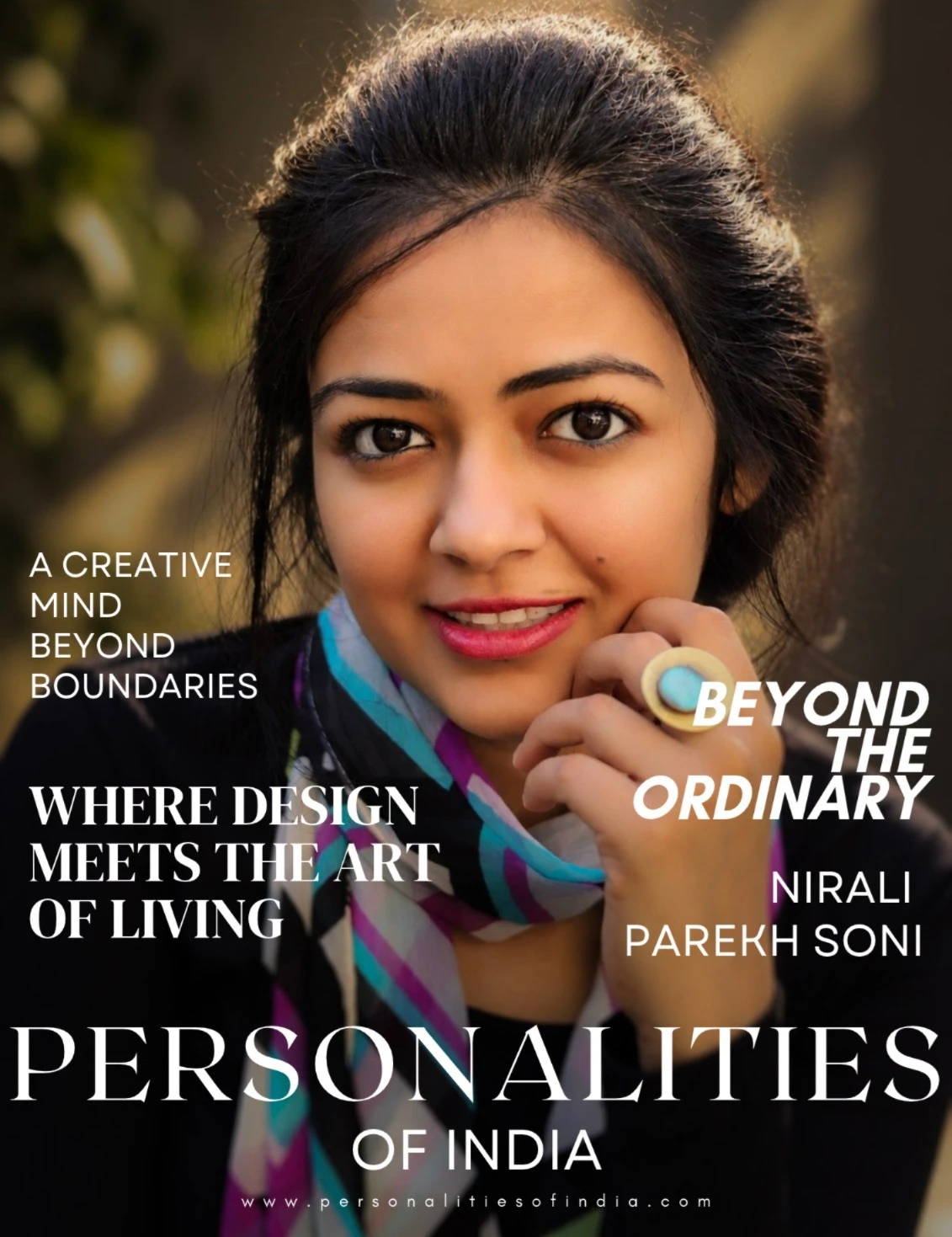
A Career That Grew Beyond One Discipline
Nirali's professional journey began in interior design, but her interests gradually led her towards other creative fields. Teaching introduced her to the value of questioning ideas and encouraging independent thought, while art and writing gave her additional ways to communicate her observations.
Over time, she developed a multidisciplinary practice that brings together design, academia, visual expression and written reflection. She has conducted workshops across diverse domains, including design, architecture, interiors, real estate and fashion, engaging with students, professionals and aspiring designers in different settings.
For Nirali, these experiences are connected by a common purpose: to look beyond established boundaries and understand how different disciplines can inform one another. Her work continues to evolve through observation, experimentation and a willingness to explore ideas from multiple perspectives.
Learning Through Uncertainty and Change
Building a career across several disciplines has not always been straightforward. Nirali's journey has included periods of uncertainty, self-doubt and the challenge of balancing different professional identities with personal responsibilities. Moving between design practice, academia, art and writing often required her to reconsider familiar definitions of what a designer should be.
There were also times when years of effort did not produce immediately visible results. Rather than measuring progress only through recognition or quick outcomes, she learnt to focus on the work itself. Teaching, creating, writing and experimenting became ways to keep moving forward, one idea at a time.
Consistency gradually became an important principle in her professional life. She learnt that meaningful work does not always develop at speed and that allowing ideas to mature can be just as valuable as producing immediate results.
Another ongoing challenge has been keeping pace with changes in design education, technology and professional practice. Nirali responds by remaining curious, learning new tools, exploring the use of artificial intelligence in design education and experimenting with visual storytelling and teaching methods.
For her, growth comes from being willing to question existing approaches and remain open to what can be learnt next.
Rethinking the Purpose of Education
Education occupies an important place in Nirali's professional philosophy. She believes that teaching should extend beyond delivering information or providing ready-made answers. Instead, it should create opportunities for students to observe, question, experiment and develop their own understanding.
Through experiential learning, she encourages creative, logical and critical thinking. Her aim is to help students become more than problem-solvers: she wants them to become solutionaries, capable of identifying possibilities, developing ideas and contributing to a better world.
This approach recognises that learning does not always follow a straight line. Research, observation, experimentation, failure and reflection all have a role in developing understanding. Not every idea needs to become a finished outcome immediately; sometimes, the process of exploring a question offers lessons that are just as important as the final result.
Her work in education has included curriculum development, competitions, exhibitions, workshops and interdisciplinary activities that encourage students to participate beyond the boundaries of regular academic work. She considers it particularly meaningful when students gain the confidence to step forward, try something unfamiliar and discover abilities they may not have recognised in themselves.
For Nirali, an educator's contribution is not measured only by what students learn in a classroom, but also by the curiosity and independence they carry beyond it.
Writing and Art as Extensions of Design
Nirali's creative interests have also found expression in authorship and visual art. She is the author of three published books: The Pause Between Architecture and Being, Designer of My Life and Kizuki 気づき. Each reflects a different aspect of her observations, design thinking and understanding of life.
Writing has allowed her to explore ideas through words, while visual art offers another medium for expressing thoughts that may not fit within conventional design practice. Her artistic journey has included group and solo exhibitions, as well as creative showcases.
These pursuits are not separate from her work as a designer and educator. They are connected by her interest in observation, reflection and the ways people make meaning of their experiences. Together, they allow her to approach familiar subjects from different angles and communicate ideas to varied audiences.
Her participation in interviews, podcasts, articles and other creative and professional platforms has further expanded the reach of her work. Opportunities to contribute as a juror, educator, mentor and workshop facilitator have enabled her to share her knowledge while learning from the experiences of others.
Through these roles, Nirali continues to build a voice that connects design, education, creativity and everyday life.
Defining Achievement on Her Own Terms
Among the milestones Nirali values most is the opportunity to build a career that brings together interior design, design education, visual art and writing. Becoming an author of three books and developing her practice as an artist represent important parts of that journey.
Her contribution to education holds equal significance. Beyond teaching and curriculum development, she has worked to create experiences that encourage students to participate, experiment and think independently. For her, helping someone recognise their own potential can be as meaningful as a professional milestone or publication.
Yet, some of her most personal reflections on achievement concern the person she continues to become. Balancing the roles of a working mother, educator, designer, artist and author has required her to manage competing responsibilities while continuing to make space for creative exploration and professional development.
She values becoming stronger, calmer, more exploratory and more dynamic through these experiences. Her understanding of achievement therefore extends beyond awards or visible recognition. It includes personal growth, the ability to keep learning and the opportunities she can create for others.
She hopes that her journey will encourage young people who are still discovering what they want to become. Her experience offers a reminder that a meaningful career does not always need to fit within a single professional label.
Looking Ahead Without a Fixed Blueprint
Nirali does not claim to have a fixed blueprint for the future. Instead, she wants to remain consistent in her efforts, continue learning and stay open to experimentation. She sees uncertainty not as a reason to stop exploring, but as an invitation to consider possibilities that may not yet have taken shape.
One direction she feels strongly about is education that develops thinkers rather than simply producing people who can provide answers. In a changing world, she believes individuals need the ability to observe, question, think critically and respond creatively to situations they have never encountered before.
She hopes to continue exploring how design, education, art, writing and emerging technologies can come together to encourage this kind of thinking. Her aspiration is to contribute to a world in which people are more curious, conscious and capable of imagining better possibilities.
The path ahead may not be completely defined, but her priorities remain clear: to keep creating, to keep questioning and to remain open to learning. For Nirali Parekh Soni, the value of a creative journey lies not only in what it produces, but also in the questions it raises, the people it inspires and the possibilities it continues to uncover.